
About co-ops
Want to learn more about co-ops in Canada?
Explore fact sheets, guides, reports and other resources that explain how co-operatives work and the difference they make in communities across the country.
What makes
co-operatives different
A co-operative is a member-owned, democratically controlled enterprise created to meet shared economic or social needs. Unlike investor-owned firms, co-operatives prioritize long-term service continuity, member benefit, and local accountability over short-term profit maximization. They are governed by the people who rely on them. Members have a voice, participate in key decisions, and help shape the future direction of the organization.
One member, one vote
Profits are reinvested or returned based on use
Ownership and accountability remain local
Decision-making is designed for long-term continuity
84%
of Canadians say stability comes from collective ownership or shared decision-making — the core principles of the co-operative model.
Co‑operatives are not a niche alternative.
They are a proven business model already embedded in Canadian life.
With one-third of Canadians already members and another third interested in joining, co‑operatives span virtually all Canadian regions, sectors, and demographics. They operate where affordability, stability, and service continuity matter most — housing, finance, food, and essential services — and are deeply rooted in communities across the country.
Canadian impact
Economic Impact
$61.1 B GDP
contribution
745,946
jobs supported
$12.3 B
tax contribution
3.6%
of Canadian employment
An Economy-Wide Presence
6,173
co-operatives, credit unions, caisses, and mutuals operating in every province and territory across Canada
Every province and territory is home to co-operatives and mutuals
20+ sectors
including housing, finance, agriculture, retail, insurance, healthcare, utilities, and food systems
People-Powered
14+ million
Canadians are co‑operative members
1 in 3
Canadians belong to a co‑operative
Another 1 in 3
is interested in joining a co‑operative
Stronger Communities
83%
say co-operatives stabilize communities
83%
say co-operatives survive tough times better
84%
say collective ownership helps build stability and security
86%
view co-operatives as accountable
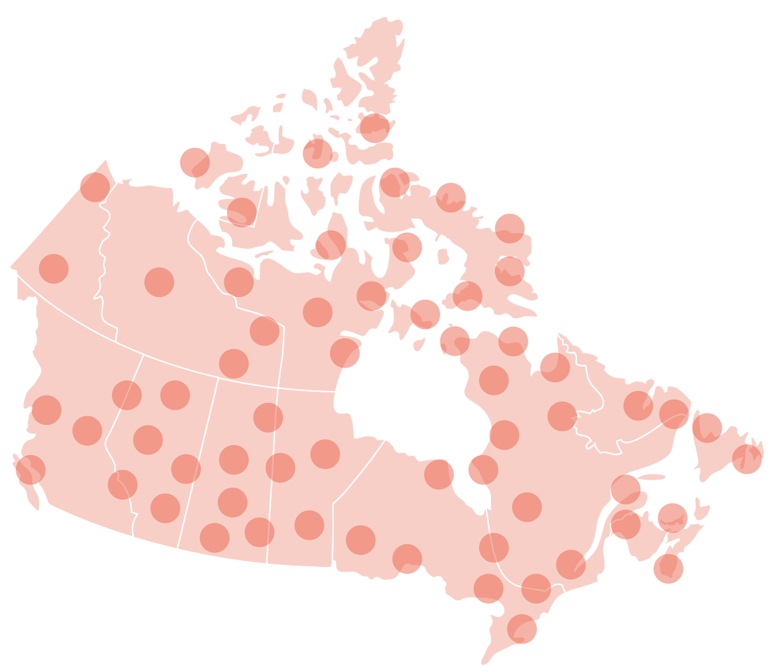
Millions of Canadians rely on co-operatives, credit unions, caisses, and mutuals for banking, insurance, housing, agricultural services, retail goods, healthcare, energy and utilities, and other essential services. In urban, rural, remote, and Northern communities alike, they help ensure that economic activity, investment, and services remain accessible and responsive to local needs.
Use our Find a Co-op map to discover all the co-operatives, mutuals, credit unions and caisses in your community.
Why co-operatives matter
- Create jobs and economic activity
- Keep ownership rooted in communities
- Build resilience during economic uncertainty
- Give members a voice in decision-making
- Reinvest value locally
- Support affordability and access to essential services
Global impact
Around the world, co-operatives are guided by shared principles that promote democratic participation, member ownership, education, collaboration, and concern for community. These principles help ensure that success is measured not only by financial results, but also by the value created for members and the broader community.
Economic Impact
US$2.79 trillion
annual turnover generated by the world’s 300 largest co-operatives and mutuals
An Economy-Wide Presence
3 million
co-operatives worldwide
Co-operatives are represented in every major region across Europe, the Americas, Asia-Pacific, and Africa
Co-operatives operate across agriculture, finance, insurance, retail, health, energy, education, and other essential sectors
People-Powered
More
than 1 billion
members
That represents at least
12%
of humanity
Stronger Communities
280 million
people have jobs or work opportunities through co-operatives
That is
10%
of the world’s employed population
Seven guiding principles
The co-operative model is governed by seven internationally recognized principles that embed democratic control, accountability, member participation, and concern for community into the structure of the enterprise. These principles ensure that ownership, decision-making, and economic benefits remain connected to the people and communities the organization serves.
Principle 1
Voluntary and open membership
Principle 2
Democratic member control
Principle 3
Member economic participation
Principle 4
Autonomy and independence
Principle 5
Education, training and information
Principle 6
Co-operation among co-operatives
Principle 7
Concern for community
A Canadian tradition
Co-operatives are often thought of as traditional institutions, but their history shows the opposite: they are consistent sources of innovation when conventional markets fail to meet basic needs. The modern co-operative model emerged from practical necessity—workers, consumers, farmers, borrowers, and communities organizing to secure fair access to goods, credit, services, and control.
Canada’s credit unions and caisses show this innovation clearly. From the earliest caisse, which expanded access to savings and credit for less affluent and Francophone communities, to modern payments platforms, credit unions and caisses have consistently used innovation to meet unmet needs.
Credit unions and caisses were early innovators in relationship-based lending and lending to women in their own names
Credit unions and caisses helped pioneer many innovations in Canadian retail banking, including advances in self-service banking, debit payments, online banking, mobile cheque deposit, and mobile payments
Credit unions and caisses have long viewed financial education as part of their mission, helping members build the knowledge, skills, and confidence needed to make informed financial decisions
Why
co-operatives matter
1800s
Early agricultural co-operatives and mutual insurance organizations emerge.